~ Articles & Snapshots ~
Links to Articles
>link< The Atkins Vs Real Food Diet
>link< Ruth's trip to the Galapagos Islands
>link< The Tarahumara Runners
>link< The Maui Weekly (an article)
>link< What about protein?
>link< Alcohol & Protein for Athletes
>link< Read 5 Chapters of Ruth's Book
>link< Miscellaneous Pictures

The Atkins Vs Real Food Diet
The most popular New Year's Resolution, according to a recent poll, is Improve Health and Fitness. Since 66% of our population is either obese or overweight, there is a great deal of interest in any diet that promises to take off weight. There is no way anyone can get around the primary principle law of thermodynamics which, in effect, says that the only way you will lose weight is if you take in fewer calories than you burn. As people get more desperate to lose weight, they will try different fad diets but if they lose their health in the process, what have they gained?
 
So, let's look at two diets: the Atkins (or any high protein diet) vs. the Real Food Diet (fruits and vegetables). This boils down to "animal" vs "plant" foods.
.
Animal

.
Advantage

Tastes good                                           
Familiar                                                  
Protein (Excess)  
.
Disadvantage:
Heart Disease                                       
Cancer
Constipation
Joint problems
Osteoporosis
Bad breath
Risk of Mad Cow Disease
...............................................................
Plant
Advantage:
Tastes good
Familiar
Protein (right amount)
.
Disadvantage:
None that I can think of...

Added Advantages to Plant Food Diet: You can save a lot of money because plant foods are much cheaper than animal foods. You also get to eat as much as you want because the caloric density is so low in plant foods. Since exercise is an important part of the weight loss equation, plant foods give you energy to exercise where high protein diets don't.  A plant food diet is also certainly much better for the animals and the environment.
Ruth E. Heidrich, Ph.D.


cartoon
"I started my vegetarianism for health reasons, then it became a
  moral choice, and now it's just to annoy people."

THE TARAHUMARA OF BARRANCAS DE CUPRE
By Ruth Heidrich, Ph.D.

I wanted to see for myself!   The Tarahumara runners are legendary for their 24-, 36-, even 72-hour runs.  On top of that stunning stamina, they are supposed to do this on a diet consisting primarily of corn!

Checking this out, however, was no easy task.  The Tarahumara, 60,000 in number, live in Copper Canyon, or Barrancas de Cupre, a very isolated area of Northern Mexico.  To get there, we traveled by bus to El Fuerte, a quaint, colonial town in the State of Sinaloa, where we boarded the El Chihuahua Pacifico Railroad, also known colloquially as 'El Chepe."  The coaches have been beautifully restored and had much of the romance of riding on the Orient Express.

Copper Canyon

The views crossing the Sierra Madre were nothing less than spectacular.  We climbed from near sea level to a high of almost 8,000 ft. Getting there entailed crossing 39 bridges and going through 88 tunnels, at times with switchbacks so extreme we could see ourselves coming and going.

Copper Canyon from train

Arriving at Divisadero five hours later, we were greeted by a few of the shy and reclusive Tarahumara selling their primary handicrafts, beautifully woven baskets.

Deer Dancer

An early French missionary named them Tarahumara.  They call themselves "Raramuri" with "rara" meaning "runners" and "uri" meaning "steep."  Because they are so reclusive, their culture has remained relatively unchanged for the hundreds of years they have lived in these canyons, four times the size of the Grand Canyon in the U.S.  Originally, they lived on the less steep areas, the fertile plains and the valleys, but with the encroaching Spaniards and Mexicans, they were pushed into the steepest cliffs.

Here, the soil was poor and growing their primary crop, corn, was very difficult.  Periodic droughts have added to their problems.  As a result, an incredible 70% of the children die before reaching age five from devastating malnutrition from not enough calories, polluted drinking water, and parasites.

Nevertheless, if a child survives, he or she becomes a runner.  They grow up playing a game called "Rarajipare."  Two teams consist of seven people on each side with a single ball.  A player lifts the ball onto the top of his foot and flips it as far as he can.  The rest of the players run to it, with either team gaining possession.  When the last player remains, the game is over.  This may take up to three days - and nights..  They play with lighted torches after dark, and their only food is tesguino, milled corn mixed with water to a drinkable consistency.  This is the mainstay (75%) of Tarahumara diet, with the remaining food being beans and squash. They also take the milled corn as their sole food when traveling, since it is lightweight, doesn't spoil, and is easily prepared by mixing it with water in a half gourd they carry with them.  This gives them great stamina and, more importantly, none of them appeared to be protein or calcium deficient with this plant-based diet.

They are such good runners that, for example, in the Leadville 100-miler in 1991, the Tarahumara took first, second, and fourth places.  All of this was run on shoes consisting of old tires cut into soles and tied onto their feet with sisal.  In fact, most all the children wore these "shoes" as well.


Bull
What About Protein?
An Article by Ruth Heidrich

One of the most frequent questions I get from athletes is how to get more protein. In their minds they are thinking that if they stuff more protein into their mouths, that it magically goes to their muscles and they will automatically get stronger. Body builders, especially, want to see hypertrophy of their muscles (without all the work). This question is especially prevalent with vegetarian or vegan athletes because they think that without meat, egg whites, or skim milk in some form, they are at risk of having a protein deficiency.

The advertising you see in magazines and health food stores plays into this fear because, of course, there is a product to sell. Protein supplements come in many forms, all with the same goal, to get you to buy their product. The fallacy is that if you want to develop a muscle, you have to overload it by putting more stress on it than it can handle. This is the ONLY way a muscle will get bigger and stronger.

OUR BODIES ARE PRETTY SMART!

Our bodies are built for economy. They will get rid of anything they don't need. If you don't need bulging biceps (or if you already have them and are not currently using them), the body will not let that muscle get a "free ride." The most vivid example is seen when you put an arm or a leg in a cast. In this case the body doesn't (and can't) use the associated muscles. When you take the cast off six weeks later, you will be struck with what you see. The arm or leg appears to have withered away. In addition, what you can't see is that the bone has also lost mass or bone density.

Now, is this permanent? No! To rebuild those muscles and bone, all you have to do is start using them and the body responds by putting on additional muscle and bone ONLY to the extent that it needs. So, for every day usage, a normal-size muscle is attained. With heavy, extreme usage, a bulging muscle is the result.

SO, WHERE DO I GET MY PROTEIN?

So where do our bodies get the raw materials (protein) to do this if you are not eating another animal's muscle (protein)? Easy! It comes from plants. The best examples are the biggest and strongest animals, elephants, horses, giraffes, rhinoceroses -- every one of them vegans! (They also happen to be the longest-living animals, another lesson buried here.) Vegetables and grains are complete proteins which means that they contain all the amino acids necessary to build muscle from scratch or to add on bigger, stronger muscles.

For example, the limiting amino acid in plant foods is methionine, one of the so-called essential amino acids. If you were to eat only rice for, say, a large male's 3000 calorie day's allotment, you would get 1.1 grams, way above the minimum daily requirement of .11 grams (about TEN times as much)! In fact, this points out one of the problems with consuming the excess protein you get from eating animal protein, that of getting TOO much protein. This leads to kidney disease and osteoporosis as the human body cannot store protein and is damaged when it has to break down excess protein.

A SIDE EFFECT OF HIGH PROTEIN INTAKE

One of the major causes of the epidemic of osteoporosis in this country is excess protein. As is generally recognized, protein is made up of amino acids. These acids are, logically, acidic -- that is, they have a pH of less than 7, which is neutral. The human body cannot operate in an acidic environment -- it must be alkaline, that is, above 7 or about 7.2. So when you take in protein powders, pills, or animal protein such as egg white, fish, dairy, poultry or beef, this acid load has to be neutralized. Our bodies have the perfect buffering system. We use the same mechanism you see advertised on tv ads for Tums and other antacids for "acid stomach", which is calcium. And where do we store our calcium? In our bones. Our bones are very active living tissue, and calcium is constantly moving in and out of them, so if we consume a high acid meal, especially animal protein, our bones are called upon to give up some calcium to neutralize or buffer this acid so that we can keep the heart beating, muscles contracting, and nerves firsing. These processes all stop if we go into acidosis, a state of too much acid.

THE ROLE OF GENES

This process of building muscle is fairly straightforward: Overload a muscle and it responds by getting bigger and stronger. Is there a limit? Of course, there is. You see this in natural body builders where genes play a role in limiting or enhancing the building of hypertrophic muscles. In order to go beyond genetics, some body-builders have to resort to the use of anabolic steroids, something our body produces naturally but insufficient in the minds of some competitive body-builders. This comes with many health risks, and, unfortunately, many focus on short-term gains and would rather risk their health in the long run.

What about women? Women are sometimes advised to get into weight training to gain or maintain muscle and bone strength, but their fear is the opposite: that they might develop these huge, bulging muscles that they find unattractive on a female. Well, they need not worry because, again, their genes control the limits of muscular development. And for those women who want to develop, say, calf or pectoral muscles, popping protein isn't the answer. The same principles apply: you've got to overload those muscles.

HOW MUCH IS ENOUGH?

How much weight to lift and how often? The body in its present state can handle "x" number of pounds. Add about 10% and work the muscle to exhaustion and then stop. Give it at least 48 hours but no more than 3-4 days to recover and rebuild, then do it again. Gradually, that muscle will be able to handle "x" plus "y" pounds. Continue this progression and you will see the muscle grow. Remember that rest and recovery is just as important as the overload. Eating a diet of vegetables and fruit will provide all the raw material necessary.

So, this is the secret to greater muscular development. The more weight the muscle has to push, the bigger and stronger it will get! You get to choose!

Ruth E. Heidrich, Ph. D.
Q & A: Wine (alcohol) and Protein
Dear Dr. Ruth,
I have two questions for you.

I read in your book that alcohol in any dose is bad for you.  Is this true of wine, too?  And the second thing... what about all the sports medicine studies that claim runners and other high endurance athletes need 15 to 20 % more protein than couch potatoes.  I figure this would mean I would need about 80 grams of protein a day and I can't imagine getting that from a vegan diet, not to mention a raw diet. Thanks for your help.
G.B.

Dear G.B.,
Yes, alcohol in wine is alcohol -- period!  It is toxic to every cell in the body as it is a universal solvent.  It does tend to thin the blood which counteracts the sludging of the blood from animal foods, and it's the sludging of the blood which leads to heart attacks and strokes -- plus many other problems.  So wine is not the answer -- not eating animal foods is.

Your second question: when athletes burn more calories, they eat more and this is how they automatically get more protein. You don't need to change the composition, just the quantity.  If, for example, an athlete burns 5,000 calories a day over the average 2,000 calories per day, that will give him/her 3,000 extra calories with an average of 10% calories from protein.  So that is 300 protein calories.  Divide that by 4 (calories per gram of protein) and you get 75 grams -- right in the ballpark you mentioned.  Don't forget that veggies have plenty of protein in them, just look it up in the charts.  Hope this helps,
Dr. Ruth
Super Athlete
 
Hawaii's own Senior Olympics gold medallist, 67-year-old Ruth Heidrich, survived cancer and tells how you can too. "This senior can kick your butt."
                   by Starr Tendo (Maui News)
~ ~ ~
Here are the clues: Faster than a diving mynah bird, stronger than the jaws of your neighbor's pitbull. She runs an average of 70 races per year, has a Master's degree in Psychology, a PhD in Health Management, holds two world records in fitness, is the author of two books, and is the co-host of a radio show.  As if that wasn't enough, she is also an eight-time Senior Olympic gold medallist.
 
Who in the world are we talking about? None other than Hawaii's own 67-year-old, Ruth Heidrich.  Leave no doubt in your mind: this senior can kick your butt.
 
She actively participates in track events, road races, and triathlons, and is a 20-year survivor of breast cancer.  She attributes a great deal of her success to her strict vegan diet. (For those of you carnivores. vegan means no  meat. no eggs, no milk...no animal products or by-products...and yes, fish is considered an animal).
 
"When I was 47 and working on my PhD, I was diagnosed with breast cancer," said Heidrich in a recent interview with the Maui Weekly. "Of course, I was devastated. I felt betrayed by my body. I mean, here I was, the most physically fit person that I knew (I had been an active runner for about 14 years) and I had cancer. It was unbelievable."
 
Heidrich underwent surgery to have the malignant lump removed. Unfortunately, further testing showed that the cancer had already spread. "The doctors found hotspots in her bones and also a lesion in her lung.
 
Heidrich decided to do what was at that time the unthinkable. Instead of receiving even a single dose of chemo or radiation, she put her faith and ultimately her life into the hands of Dr. John McDougall.
 
At that time, McDougall was researching the effects of a vegan diet on breast cancer. He put Heidrich on a vegan diet and monitored her. To make a long story short, Heidrich has never undergone any type of conventional cancer treatment and has been cancer-free for 20 years.
 
"My body actually encapsulated the lesion in my lung," she said. "It's great what your body can do with the right type of nutrition."
Continued at the next colume:  >click<


continued from the left colume

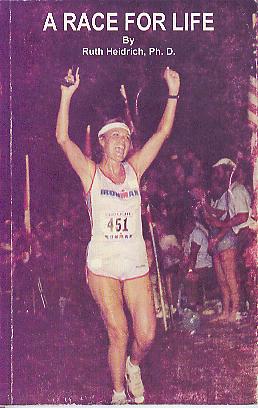
There are no ifs, ands or buts about it. The decision to go vegan changed Heidrich's life. She has authored the book and video, "A Race For Life' and also wrote "The Race For Life Cookbook", a guide to cooking delicious and healthy food for optimum health and nutrition.
 
Recently Heidrich came to Maui to talk about reversing the aging process and improving athletic performance. The free event was sponsored by the Vegetarian Society of Hawaii.
 
Heidrich explained that Americans tend to think they need a lot more protein than they actually do. And according to her, too much protein, primarily animal protein can lead to big trouble. "I've seen people die from the 'all protein'-meat' diet," she said. "People are always talking about their cholesterol. Well, cholesterol is in animal protein. Animal protein can lead to and aggravate arthritis, osteoporosis and of course, heart disease."
 
For those of you out there who have osteoporosis, you've probably been told by your doctor to eat more protein, like fish, and participate in some sort of exercise that will help to rebuild your bones.
 
Heidrich said that the recommendation to consume animal protein to help rebuild bone is misinformation. "When you eat four ounces of fish," she explained, "your body goes into an acidic state. Your body cannot function or live in this state so it needs to balance out again."

You know how when you get indigestion, you take a Tums? It's a calcium tablet. Calcium is an alkaline that counteracts the acid to make your tummy feel better again. It works the same way with the Ph levels of your blood. "Your body will actually pull more calcium out of your bones to buffer the protein that you ingested from the fish." she said, the last thing that you need when dealing with osteoporosis is more calcium being pulled from your bones."
 
Heidrich is a living example that the right diet can make all the difference. Whether you tend to be conservative and traditional in your health views, or unconventional and liberal, it may be a good idea to talk to your physician about how you can benefit from a vegan diet. It's your life, ask questions and don't stop until you get an answer backed by fact.
 
Heidrich encourages the people of Maui to be healthy and eat to live.

 ~ ~ ~
For more information, please visit Ruth Heidrich's website at www.ruthheidrich.com

Ruth Heidrich, part of the US Senior Olympics Relay Team, carries the Olympic torch 7 miles to kick off the Aloha State Games.
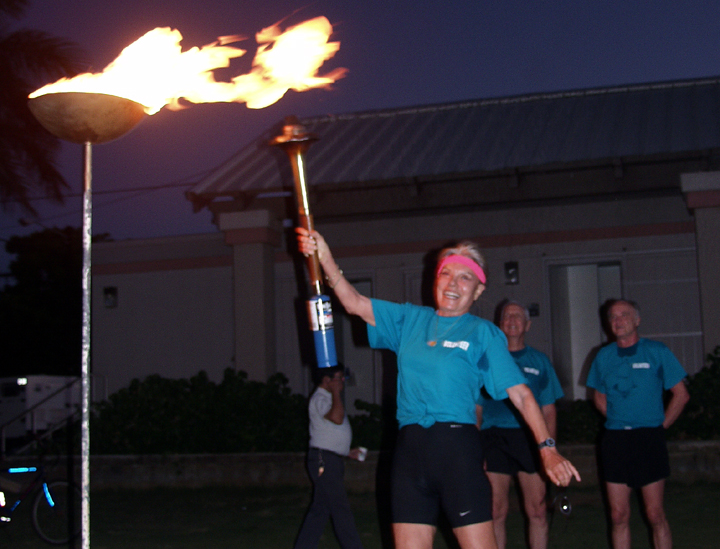
torch  
book Race For Life
Top of the Page >click<
Back To Home Page >click<