See
stunning
photographs and read stories
of
Ruth Heidrich's treks to...
~ Globe Trotting Adventures ~
Running
'Round The World:
>FastScroll<
Costa
Rica -- Pura Vida: >FastScroll<
Hubbard
Glacier off the Alaskan Panhandle: >FastScroll<
Machu
Picchu & The Galapagos
Islands: >FastScroll<
The Tarahumara of
Barrancas de
Cupre: >FastScroll<
A Caribbean
Wellness Cruise: >FastScroll<
Return
to Dr. Ruth's
Home Page: >click< |
Running 'Round The World
|
Eating and
Running ‘Round the World
by
Ruth Heidrich, Ph.D.
“Round the World in 30 Days!” Considering the possibilities,
twelve
different countries, looking at how twelve different cultures eat, and
fulfilling a lifelong dream of running ‘round the world – all this was
suddenly within the realm of real possibility for me. The itinerary
sounded perfect. It started at Whitehorse in the Yukon, Canada’s last
frontier, then a re-fueling stop in Petrovastok, Russia; next, to the
ancient capital of Japan, Kyoto; Hong Kong, China; Ho Chi Minh City,
Vietnam; Siem Reap (Angkor Wat), Cambodia; New Delhi and Agra (Taj
Mahal), India; Dubai, UAR; Nairobi (Masai Mara safari), Kenya; Cairo
(Pyramids), Egypt; Prague, Czech Republic; and Reykjavik,
Iceland. In addition, we’d have our own aircraft, a Boeing 757,
and crew, who would be going with us. My partner, Bob, also a runner,
agreed, so in the words of the goddess, Nike, we were going to “Just do
it!” |
Preparations were minimal, although I did inform the tour leaders that
Bob and I were both vegan (strict vegetarian) and requested vegan foods
throughout which at first seemed to present a problem in three
countries; the main entrée at a dinner in Vietnam was “elephant
ear fish,” in Dubai was steak shish kabob, and in Nairobi, dinner at a
restaurant called “The Carnivore,” famous for serving the flesh of the
very animals we’d come to the preserve to see, e.g., camel, crocodile,
ostrich, monkey, and more. These challenges were resolved easily
by just notifying the servers so that they could just serve us veggies
instead of the fish, put veggies on the shish kabob, and that we would
just skip the meal at The Carnivore as a rather impotent form of
protest. So, armed with visas, travel shots, anti-malaria meds,
and a great deal of excitement, it was off to the first stop,
Whitehorse. Since this was November, we knew it might be cool,
but certainly not too bad since, after all, it was still autumn.
|
.
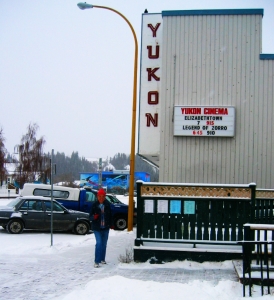 |
First, as soon as we got off the plane, the contrast in the weather was
a real shock. It was snowing and alternating freezing rain that made
for very tenuous running conditions. Putting on all the clothes I had,
I managed only a very short, chilly run. One of the possible
highlights of the Yukon was seeing the Northern Lights, the Aurora
Borealis, but the weather did not cooperate. The Yukon is also
known for its prolific wildlife. For example, it is said that moose
outnumber humans nearly 2:1 and caribou 6:1, and we did see a few of
both which compensated somewhat for not seeing the Northern Lights.
Then it was back for dinner. The main entrée turned out to be,
unfortunately, reindeer! It was hard for me to understand how
people can, first, admire, then kill and eat these beautiful animals,
but then I thought, how is that different from killing and then eating
gentle cows, intelligent pigs, friendly chickens, and beautiful
fish. My first “vegan” meal was some kind of pasta that I hardly
touched because it was loaded with cheese.
The next morning one hundred very excited passengers boarded our plane
and headed for our second stop, Petrovastok. Once we crossed the
Pacific Ocean and approached Russia, I was amazed at the volcanic
landscape. Mountain after mountain for what seemed hours, and at
last, when we were scheduled to land, it seemed we skimmed the very top
of a particularly high volcano, then dropped down to a low altitude,
encircled a broad bay, circled around it a second time, and, finally,
we could see our destination. We landed on a very old,
dilapidated runway with remnants of military aircraft, bunkers, and
lots of fully armed Russian guards watching us. I guessed it was
an ex-military base, and it certainly did not look like it was very
busy as we were the only plane on the ramp. There were a few very
old-looking aircraft parked alongside the runway of a design that
seemed out of a Buck Rogers comic strip, looking as if they hadn’t been
flown since the end of the Cold War. I was disappointed
when we were told that we were not allowed off the plane. In fact, we
were not even allowed to take pictures. We finally were able to
get permission to take a few photos, but it was a challenge as most of
the one hundred people on board all crammed into the small doorway to
try to photograph this unique setting with the antiquated re-fueling
equipment and especially the ancient terminal with the name of the
airfield in large Cyrillic letters. Then, looking down on
the runway, we could see lots of gesturing, frowns, and some obvious
signs of disagreement. I asked one of the crew what was happening and
was told that the Russians weren’t going to accept our currency! We
watched anxiously as the crew negotiated on the ground with a group of
Russian soldiers. I have to admit that I was getting very
nervous, imagining the worst, that we could be held hostage, flight
delayed, or even our aircraft confiscated. It was with a long
sigh of relief when the re-fueling process was complete, and we were
finally led down the taxiway by an ancient vehicle and onto the main
runway and cleared for take-off. Even our very experienced pilot
admitted later that he was nervous and relieved when we were safely
airborne again. He said later that he was still trying to figure
out why we were led in by the Russian flight control right over the
highest mountain around and then that circuitous route around a
sparsely settled bay to the runway. I suspect that even he was doing a
bit of catastrophizing!
The next stop, Kyoto, was much more to
my liking. Well, that was
when we finally got to Kyoto. We actually landed at the new (and
appeared to me to be unfinished) airport in Osaka. Customs and
Immigration went very efficiently, and we were led to buses that were
to take us to our hotel in Kyoto, which we didn’t know at the time was
more than two hours away. After going through the heavy traffic
of Osaka and then the long ride to Kyoto, we were quite tired by the
time we checked in, but I was instantly revived when I saw our
room. It was ultra, super modern with a flat screen TV plus in
the bathroom, a toilet that, with the push of the right button, washed
and even dried your bottom.
The next morning our
breakfast buffet was
designed obvious to please both Western and Asian tastes as there was a
great spread of all varieties of fruits and veggies, including sea
vegetables, mizuna, gobo, lotus root, tofu, pickled white radish, taro,
miso soup, the typical eggs, bacon, pancakes, and, surprise, blueberry
syrup right next to the large bowl of organic greens. Our first
dinner was at the top of a revolving restaurant, famous for its gourmet
$200 dinners. These, of course, were meat-centered, so when the meat
course was served, I got a delicious pumpkin soup and steamed
veggies. Dessert was seeded watermelon (I love those tasty,
crunchy, zinc-loaded seeds), cantaloupe, and honeydew. The next
night we had dinner at another more Japanese-style restaurant which had
seating on the floor, large pots of steaming, flavored water (shabu
shabu) for dipping in morsels of food (in my case, greens) to cook, and
entertainment by elaborately- kimonoed geisha and a maiko, an
apprentice
geisha, and, the highlight of my evening, taiko drummers. Two of
the six drummers were women, and it was fascinating to see the contrast
between women in kimonos with their white-mask make-up, elaborate
hair-dos, and bowing, subservient mien contrasted to the strong,
powerful women beating large drums with all the tremendous energy they
could muster. We were seated right next to the drums and as much
as I love taiko drumming, I was sure that I was going to leave there
with my hearing impaired. The next day we were treated to a kimono
fashion show, which displayed a variety of beautiful silk embroidered
fabrics and styles as well as headdress and shoes. Some of these
kimonos cost up to tens of thousands of dollars. We then were taken
upstairs to see the beautiful silk fabrics being woven on ancient looms
as well as many other arts and crafts that are distinctly Japanese such
as wood block prints and landscape paintings.
|
|
.
 |
We also got to
visit the Todai-Ji Temple with the world’s largest wooden structure and
the “great Buddha of Nara” which is 45 feet tall and weighs 25 tons,
and the Nijo Castle built in 1603, famous for the “nightingale” floors
that squeak so as to let the guards know if anyone was sneaking
in. From there, we went to Nara to visit the famous Deer Park.
There are over 1,000 very tame (but aggressive if they think you’ve got
something edible, even sometimes your clothing!) deer just roaming
around the park and also what seemed like thousands of stone lanterns.
This was especially meaningful for me,
because exactly twenty years
ago, I visited that park the day after doing the Japan Ironman
Triathlon. |
It was on the bus to this
park that I
casually opened a
newspaper folded in the seat pocket in front of me to find a photo of
me at the finish line and the article titled, “American Woman Conquers
Cancer; Conquers Ironman.” I was so excited I let out a squeal, and, of
course, everyone looked at me. I pointed to the picture and as luck
would have it, the man across the aisle was an English professor at
Kyoto University. He stood up and read aloud in Japanese to all the
passengers, the story of how this woman from Hawaii got breast cancer,
changed to a vegan diet, and came to Japan to compete in the Ironman
Triathlon and win first place in her age group! It was, and still is,
amazing to me how life can have such incredible turns. The next
morning it was back on the bus for our two-hour ride back to our plane
in Osaka. The countryside was beautiful with lots of rice fields
and forested areas, but also the bane of civilization, the construction
of freeways.
After a short hop on our plane, we arrived in Hong Kong. We were
in store for an interesting experience. As we cleared Customs,
two young women were standing on either side of the exit, unobtrusively
pointing an instrument at each passenger’s head as they passed.
They were taking the temperature of all the arrivals! Most people
didn’t even realize what was happening. Thank goodness, we must have
all had normal temperatures and no avian flu, because none of our group
got stopped. Hong Kong was also more veg-friendly and that evening we
had a memorable meal at the top of Victoria Peak after a thrilling ride
up a very steep, seemingly vertical hill on the tram.
|
| The view
was breathtaking and not for the faint of heart as the restaurant and
its seamless glass wall seemed perched right on the edge of the
mountain. The city lights at night were an
amazing sight and dinner was
a seemingly endless buffet with dozens of different salads and a
variety of veggies such as snow peas, eggplant, jicima as well as the
standard fare. The dessert spread – well, let’s not even go
there. The next day we boarded the Star Ferry to cross over to
the mainland to visit the famous Stanley Market where there were so
many little shops that one could easily get lost in the maze of
merchandise of every conceivable type. From there we went to
Repulse Bay with its very beautiful beach and to the Hong Kong harbor
for a boat ride to visit the Aberdeen fishing village, where people are
born, raised, and die on their boats, and then it was across the busy
waterway to a memorable meal at a Jumbo floating restaurant. I
was delighted to find that they had made preparations for our vegan
versions of dim sum. I was, however, a bit disappointed to see so
many of the fast food chains, not only there but in most of the places
we visited. |

|

|
Ho Chi Minh City is an amazing place because millions of people are
crammed into a very small area and each one of them has a motor
scooter. Traffic lights, stop signs, and white lane lines are merely
“suggestions” because it seems that no one pays any attention to
them. Traffic goes both ways in each lane! Running there
was a real challenge, especially trying to cross a street. I ended up
just making all left turns, going round and round my block so I could
live to tell this tale! But swimming was a whole different
matter. The hotel had an Olympic-size pool, and I really enjoyed doing
laps in an amazingly beautiful setting, a novelty, I’m sure, in the
middle of what used to be called Saigon. The meals were buffet so it
wasn’t a problem getting lots of fruits and veggies. |
Our second
day there we were treated to a boat ride across the Mekong Delta to a
small island village, My Tho. We were served that one meal of
“elephant ear fish,” but for the two vegans, a “special” meal was
prepared, an elegant coconut dish plus coconut milk served out of a
coconut. After that delicious meal, we all walked a few feet to a
dock next to a small canal and, two or three at a time, got into their
version of canoes and were rowed through thick jungle to the other end
of the island to board the larger boat back to Ho Chi Minh City. All
along the way we were all warned never to eat raw fruit or vegetables
because of the risk of contamination. If I’d followed that rule, I’d
have starved. Ironically, the only ones who got sick were those eating
meat!
|
Our next
landing was in Cambodia, a country in my mind steeped in mystery and
intrigue. From the moment the plane touched down, I was struck by how
different it seemed. First, there were no other aircraft to be seen,
either on the runway or in front of the terminal. In fact, we were the
only ones in the whole place. Customs was a breeze and as soon as we
exited the small building, we were met by a group of people holding a
sign saying “Welcome to Siem Reap.” We were each then
presented with a beautiful bright red scarf, which they said we would
need to wipe the sweat from our brows. And it did come in handy,
as this was definitely the tropics, although it seemed rude to put that
beautiful scarf to that use. Siem Reap is tourist-oriented
because it’s the site of one of the seven wonders of the ancient
world. Angkor Wat, without a doubt, is one of the most
breathtaking architectural masterpieces left standing in the world
today. It’s estimated that more than a million people lived
there, making it the largest city in its time.
|

|

|
Seeing the
thousand-year-old structures, some almost overgrown with gigantic
gnarled trees, was an experience beyond belief. The sheer size of the
stone-carved structures plus the moat around the compound made me
realize why it was a sight that people come from all around the world
to see. Eating was not a problem here, either, as Cambodians
still eat mostly plant foods. Almost all the meals were buffets served
in the hotel and with selections for both Western and Asian
tastes. Running there was especially challenging because of very
rough what passed for “sidewalks.” People stared at me in
disbelief as the concept of running for exercise is foreign to them, so
I just smiled and kept my eyes on the rough terrain. Although
there were very few cars, it seemed as though I was running against and
through a locust of cyclists. Three blocks from our hotel I saw
one of the very few signs in English: “Secretariat of the Marathon
Ministry” and am still wondering what that was all about. An
interesting little vignette occurred a block later while running by a
hospital. All of a sudden a gate dropped down on both sides of the
street, and here came two people nearly running, pushing a gurney
across the street with a small child barely covered with a sheet and
hooked up to an IV. Seeing this child so sick just brought tears to my
eyes! |
Next stop was India. We landed in New Delhi and, again, were
immediately put on a bus to take us to Agra, about five hours away. Our
route took us through parts of Delhi where we saw the most extreme
poverty. Running in India was almost as much of a challenge as running
in Ho Chi Minh City because of all the traffic congestion plus there
were so many vendors spreading their wares on the sidewalks. Also, I
couldn’t go very far without being approached by someone either asking
for money or offering guide service.
|

|
This was despite the fact
that it should have been obvious that I was out for a run, but then I
guess they weren’t used to seeing runners. It was sad to see so
many maimed children having to beg for a living, to see people just
throwing garbage onto piles on the street and sidewalk as there was no
such thing as “garbage collection” or even garbage cans, and to see so
few toilets that it was common to see people urinating on the street.
Even when toilets were available, one had to pay to use them. In the
midst of all this poverty, we saw lots of young men riding white
horses! We were told that these were grooms going to the home of
the intended bride. The reason there were so many is that this day was
determined to be an “auspicious” day for marriage. They believe
that if they weren’t married on the “right” day, as determined by the
stars, their marriage would be unhappy. This occurs despite the
fact that 85 % of all marriages are arranged, dowries are extremely
important, and women have little to say about this, their education, or
anything else. In addition, our tour guide told us that twenty million
babies are born every year in India! The population is already 1.2
billion! Compulsory education is only to the eighth year. The
caste system is technically illegal but is, unfortunately, still all
too common. There were also lots of free-roaming “sacred” cows, dogs,
goats, and even pigs.
|
Then there was the
contrast of the Taj
Mahal! To see such a magnificent marble structure, so beautiful
in scale and design is to appreciate what beauty can be created out of
stone. It is rightly claimed to be one of the most spectacular
buildings in the world. Indian food is primarily vegetarian so
dishes such as dhal and several kinds of curries were always available,
even for breakfast!
|
.

|
The next extreme was
Dubai. I’d heard of streets paved with gold
and this was the closest thing to that. From the moment we landed, I
was aware of being in the Middle East with women covered head to toe in
black, some with only tiny slits with only their eyes showing, and men
in long, billowing sheik’s clothing and the standard Arabian
headdress. Dubai is a city in motion as its skyline is a
continuous maze of cranes. Hundreds of high-rises are popping up
everywhere I looked. Everything seems to have the touch of
luxury.
Building design reaches extremes in
height, width, and curves,
and lots of the priciest luxury cars and limos with none over two years
old, because they were shipped out of the country when they got that
old. We also saw, believe it or not, where one could ski in the
middle of this hot, even in November, desert city! Well, it’s not
quite what you’d expect as it was contained within a very large, maybe
four stories high, enclosure with a ski lift, artificial snow, with
construction costs a measly $272 million. It is said to be the
largest snow dome in the world as Dubai is seeking to be a major
tourist hub. There was the older section of the city where the gold
‘souks’ were, shop after shop of more gold than I’d ever seen in my
life or could even imagine. The store windows were practically stuffed
with gold bracelets, gold necklaces, gold rings, all ornate and
beautiful. All our meals were buffets in our 5-star hotel so, again,
lots of fruits and veggies including dragon fruit, passion fruit,
dates, lychee, guavas, mandarin oranges, mango, and even macadamia
nuts. Our rooms in Dubai were the most luxurious of all, and at
$800 a night, I guess they should have been. There was a large flat
screen TV, architectural niches with antique vases, a marble bathroom
to die for, gold fixtures, both a shower and tub, a bidet, and
amenities included full size bars of soap, a loofah, and a sewing kit
with four regular-size spools of thread. A reminder that we were in the
Middle East: next to the bed was a rolled-up prayer rug and on the
ceiling was an arrow pointing to Mecca. From our room we looked
down to the very large pool, whirlpool, and slides and next to the
pool, was a restaurant with a large hookah at each table. I assumed
these were just for decoration until that evening when I saw that
people were actually smoking them!
|
We were right on the
Arabian Sea so
I got to do a beach run topped off with a refreshing swim. They
also had a Fitness Center with the very best of equipment. Our
second night there we were treated to a dinner out in the desert at a
Bedouin camp. To get there, we were strapped into 4-wheel drive
Jeeps and taken over desert sand dunes so rough that I was afraid at
times we would tip over. It was such a relief to finally reach our
destination – safely! This was where I got the veggies on a skewer in a
setting imaginable only in a movie. We were escorted to a large tent,
the walls of which were covered with Persian rugs, the floors all thick
cushions to sit on, and low tables laden with the most
delicious-looking food.
|
..

|
It was a scene out of
Arabian Nights,
especially when live exotic music complete with a belly dancer was
added. When it was time for the trip back, we didn’t need to be
reminded to fasten our seat belts because, this time, we knew the wild
ride which awaited us. Our driver seemingly took great delight in
giving us the ride of our lives! The next morning we left Dubai barely
ahead of a sandstorm, so thick that it shut down the airport minutes
after we departed.
Our next stop was Nairobi, Kenya. After clearing Customs, we were
met with 17 Land Rovers, six of us to a vehicle and driven to the
Norfolk Hotel in downtown Nairobi. This was the evening meal that was
scheduled for “The Carnivore” so Bob and I had a nice plate of veggies
for our dinner at the hotel. The next morning we were put in
those same vehicles and driven nearly six hours to the lodge. It
wouldn’t have been so long if there had been a road, but, for much of
the way, there were no roads and at times not even a path. Lots of
bumps and deep ruts but scenery so beautiful as we looked out for miles
over the Rift Valley where not only did elephants, lions, zebra,
gazelles, and giraffe roam, but where archeologists uncovered bones of
the first hominids.
|

|
At about the halfway
point, we
stopped for a
visit to a Masai Warrior village. We were greeted by a group of
tall, lean men dressed in bright red and carrying spears. For
US$20, we were allowed to go into the inner circle of dung/mud huts and
observe their living quarters. We were told that when women reached
marriageable age, she built her own hut where she would live after
marriage and with her children. The huts were small (one-room), dark,
except for a small fire on the dirt floor for cooking, and had colorful
quilts on the floor for sleeping. We were then told that the $20
we paid was going to help build an elementary school for the children.
|
Then it was back into the
Land Rovers
for another three hours of more
bumpy, kidney-blasting, hang-on-for- dear-life riding. When we finally
arrived at the lodge, the Masai Mara, we were escorted to our rooms,
all of which overlooked a river and had individual private balconies
for evening and morning viewing of animals at their most active
times. It was an enchanting sight with crocodiles and hippos
lazing on the banks of the river just a few feet below, and large birds
of many varieties nesting in the trees at night including very large
storks. We were fascinated as we watched one, then two, then three, and
on until nightfall when the tree was filled with nesting storks.
|

|
.

|
Early the next morning, it
was the same
sequence in reverse, with first
one, then several, then all the rest flying away for the day. We
had to get up early because this is the best time to view the wild
animals searching for breakfast. We got back into our same vehicles,
but this time the top was raised straight up by about two feet. This
meant we could stand up and have clear 360-degree views of all the
animals. We were just barely out of our lodge when Bernard, our
driver, pointed to the left at a large herd of giraffe. These
magnificent animals were grazing at the tops of the trees, and it was
clear that their long necks were a distinct advantage when it came to
mealtimes. Just moments later we saw a large group of zebras.
They are so striking that it looked as if their black stripes had been
painted on. One of the most spectacular sights came a bit later,
a whole herd of elephants, including two babies, trying hard to keep up
with mama.
|
Different varieties of
animals came so
fast that I was
overwhelmed with what I was seeing. Lions, Thompson gazelles,
hyenas, Cape buffalo, monkeys, helmeted warthogs, hartebeest, jackals,
guinea fowl, and so many others I’d never heard of and couldn’t
remember because I was too busy looking to take notes. Because
these animals were so accustomed to these vehicles, they all just
ignored us. At one point, a giraffe headed our direction and sauntered
slowly across the road in front of us. This presented one of my best
ever “photo ops”! Of course, we were not allowed to get out of
the vehicles, so I was very thankful for my zoom lens on the
camera. This allowed close-up views although I was wishing I
could get even closer.
|

|
| Our driver was told by his
communications
with other drivers that there was a rhinoceros with her baby not far
from where we were, so Bernard did a quick U-turn and headed across a
bumpy field, through some brush, down a stream embankment, and up to
the edge of a small-forested area. He got out his binoculars but
could see nothing, so we waited – and waited – and waited.
Several times we swore we saw some movement but nothing that was
clearly a rhino. I took a photo of that area and imagined that
with enough megapixels that I could point to it and say, “There it
is!” Thinking back about the offerings for dinner at “The
Carnivore” seemed such a sacrilege and, thankfully, even some of the
other travelers agreed that eating those beautiful animals was going
too far. Because we sat out that dinner at The Carnivore, others told
us later that they did have a vegetarian option! The safari
company wanted to present us with t-shirts, so after dinner our last
night there, we were told to pick one up as we left. Because I was
really excited about getting a Kenyan t-shirt, I ran to get in the long
line that had already formed. When I got to the front, I was
handed a t-shirt that looked extremely large. I checked the size and it
was, indeed, an extra-large. I asked if I couldn’t please have a
medium. I was told that all the t-shirts were extra-large
because, after all, he said they thought that all Westerners were
extra-large! Unfortunately, he was almost right, but I still cherish my
Kenyan t-shirt, anyway! |
.

|
Then came the Pyramids and the Sphinx at Cairo. I was truly in
awe at the massive size of another one of the wonders of the ancient
world. The city of Cairo itself was typical of most large cities
– too much traffic, too many people, and lots of smog although I must
admit that running alongside of and then crossing the Nile River was
one of my peak running moments. I almost had to pinch myself as
the impact of where I was sank in. Eating here, though, was more
of a problem, as it seemed every dish had some meat in it. Thank
goodness for eggplant as that seemed to be one of their staple foods
plus lots of salads. There was never a shortage of desserts of
every ilk, however – all very sinful and definitely not of vegan
persuasion! One of our dinners was on a cruise on the Nile complete
with live entertainment consisting of another belly dancer and a
whirling dervish who did wonders with his cape.
|
The next day we
were treated to a visit to the Cairo Museum, which had more exhibits
than one could possibly visit in a month, but the most popular exhibit
was that of King Tutankhamun from more than 3300 years ago, which was
discovered buried in three nested gold coffins. Another visit was
made to a papyrus “institute” where we were treated to a demonstration
of how the ancient Egyptians made papyrus. There were also large and
small papyrus paintings that were so beautiful that one of the members
of our group bought $2000 worth! I was sorely tempted myself, but
with limited wall space on which to hang more art, I reluctantly
passed. I did, however, succumb to a 22-carat gold cartouche,
which I proudly wear around my neck on my Kenyan t-shirt. It has
hieroglyphics on both sides, one of which spells out “Ruth” or so I’m
told.
|

|
Getting out of Cairo was another
mini-adventure. After a
long bus ride, over an hour just to go a few miles because it was rush
hour, we got to the airport, breezed through Customs and Immigration,
and were ushered into a waiting room where we waited, and waited, and
waited. First, the time for boarding passed, and then the time
for departure passed, then we all started getting very nervous since no
one was allowed to leave the room, and we weren’t told anything about
what was happening. We just knew it couldn’t be good! Finally, we
were told that airport officials could find no record of our having
pre-paid our fuel charges.
Our crew then had to phone the
headquarters in Toronto, wake somebody up since it was the middle of
the night there, duplicate the invoice, and fax it to Cairo. By
that time our flight plan had expired and we had to file a new
one. The only problem was our route was to take us over Bosnia,
and it had taken months to get bureaucratic clearance to enter Bosnian
airspace. By this time, that had expired, and we were not allowed to
follow our original flight path and had to deviate, fly around Bosnia,
which delayed us even more than the two hours delay at the Cairo
Airport, and by the time we arrived in Prague, three hours late, all
but one person of our welcoming committee had gone home. In addition,
there were only two buses there when we needed three, so we had to
crowd onto the two buses and leave our baggage behind for later
delivery. All of these hassles combined led to some very unhappy
people, but once we were settled in to our hotel in Prague, everybody
soon forgot the trials of just getting there.
|

|
Prague, the city of spires and castles, and the only major European
city that wasn’t touched by the destruction of WWII, was worth
it! Visiting the ancient Prague Castle and walking across the
Charles River were exciting moments as I realized that these structures
were hundreds of years old. This was back to freezing, cold weather, so
again, I had to dig out all the warm clothing I had – and still almost
froze to death! Running on cobblestone streets presented a challenge,
as I sure didn’t want to trip and fall, so my eyes were carefully glued
to the rough terrain ahead of me. |
| But one of the nicest runs
I had was
on an early Saturday morning when Old Town was practically deserted. No
cars, no people, (and no one to take a running picture, unfortunately
for me) just like a Renaissance still life painting – except it was
definitely real! Food choices again were primarily buffet so
there were lots of choices of fruits and veggies for all
meals. |
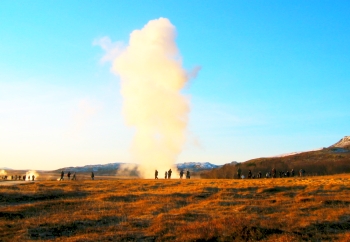
Iceland! Just the name inspires scenes of fire and ice, and, yes, there
were plenty of both. Seeing shooting geysers and thundering waterfalls,
active volcanoes with lots of lava, and giant miles-long rifts in the
earth are enough to put one in stark awe of this amazing country. In
fact, gaping down one of these rifts, one could not see bottom.
We were also treated to a concert of Christmas carols sung by young
Icelandic children. This was unique because the group of about
twenty did not merely stand on a stage in front of us.
|

|

|
They each
headed in different directions, walking through our group, and
serenaded us individually. It was fascinating to look so close up
into the eyes of these children and wonder what they were thinking of
us. One of my most memorable runs of the whole trip was running
at 10 am in complete darkness. We were told that there was a
restaurant on the top of a nearby hill, Oskjuhlio, which got all of its
energy from an underground thermal spring. Bob and I ran, in
total darkness, to the top of that hill, and marveled at where we were,
one of the most unique places we’d ever run!
|
| The sun went down again at
4 pm, so it made for short days. Then a swim in the Blue
Lagoon, a natural warm-to-hot, truly blue thermal waters amid recent
lava flows with below-freezing temps topped off the visit to a truly
remarkable and, except for buffets with nine different ways of
preparing herring, it was a surprisingly veg-friendly
country. Our tour guide, Elisabet, was vegetarian although
the Icelanders spell it “vegeterian.”! |
 |

|
.....................................................
|

|
My one disappointment was in seeing so little of “local” foods.
Each of the countries gears up for tourists, and since most of them are
what they consider “rich Westerners”, they supplied the foods that they
thought would please us. I really would like to have tasted the
foods that our hosts in each country eat in their homes. In any
case, it was indeed a dream come true – to see so many different
cultures and countries, to eat so many different foods, and to run in
so many different places – truly, eating and running ‘round the world.
Ruth Heidrich
(c) 2007 Ruth
Heidrich
Top of the Page
>click<
Back To Home Page >click<
|
Costa
Rica -- Pura Vida!
|
Pura
Vida, or Pure Life, gives just a hint of the typical attitude of the
warm and friendly people of Costa Rica. The country has no army,
cares for its land by promoting eco-tourism, and has a love of visitors
to whom they enjoy showing off their beautiful country. Beautiful
beaches, active volcanoes, savannas, and lots of rain forests inhabited
by hundreds of species of rare and unusual wildlife. This avian
Eden with its different micro-climates includes the brilliantly-colored
beaked toucans and macaws, tropical flowers, brilliant blue
butterflies, and lots of iguanas, monkeys, caymans and crocs.
Those
of you who know John McDougall may know he puts together adventure
trips with each day a new adventure planned.
|

|
| The first day was
orientation and exploration of the area including the Ocotal Resort
facilities: pools, jacuzzis, a gym, our private beach, the many
resident iguanas and birds, and several beautiful off-shore islands. We
also got our first taste of the Costa Rican culture in the town of Coco
Beach with its grocery store (not much different from ours -- same
logos but the brand names were in Spanish), kayak rentals, and the
obligatory souvenir shops. Spanish is the native language but
most local folks spoke enough English to get by and even took our
American dollars. |

|
The
second day was a nearly two-hour bus ride to the Buena Vista ranch high
in the volcanic mountains. We were treated to an acclaimed
age-reversing mud pack (I'm not sure it worked on me, though) and then
a cleansing soak in the hot volcanic thermal springs. The brave ones
among us visited a reptile farm, where we viewed many of Costa Rica's
snakes, poisonous and non-. During that long bus ride, we were
able to see where large tracts of rain forest had been cleared for the
increasing amount of cattle-grazing as Costa Ricans, like most people
around the world, crave more hamburgers and steaks. |
| The
third day we were fitted with climbing gear necessary for the tree-top
zipline canopy ride. This was truly adrenaline-pumping as we soared at
35 mph hooked to cables high above the rain forest. What a feeling --
flying like birds, high above the trees which stretched as far as you
could see. As soon as we regained stable land-legs, we visited a
butterfly farm where we saw dozens of species of all sizes and colors
flying all around and even landing on us. |

|

|
The
fourth day was our river rafting adventure. We were fitted with
life jackets and then climbed aboard a zodiac-type rubber raft, deftly
steered by a local guide who pointed out both howler and capuchin
monkeys, iguanas, crocodiles, caymans, and even bats as we glided
peacefully down the river. We then visited the Native Cat Park, a
sanctuary for orphaned and injured bobcats and jaguars. It was very
exciting to see these animals so close -- within inches and separated
by only a chain-link fence.
Our
fifth adventure was a trip by small motor boat up an estuary with its
|
| mangrove swamp and
unique wildlife including
more crocs and a large
colony of howler monkeys, many with babies on their backs. It was
fascinating to see the jungle growth, trees with large tangled prop
roots jutting into the mix of fresh and salt water. |
The
last adventure loaded us up into dive boats and headed out to sea. We
were treated to schools of playful dolphins following us, dipping and
diving across our bow wave. I think the humans were as excited as the
dolphins appeared to be, judging by the oohs and ahs! We arrived
at some of the smaller islands where we stopped and did some snorkeling
and swimming.
In
between all these adventures, we were treated to the most delicious
vegan buffet lines. Platter after platter of exotic colorful
fruits such as rambutan, mango, guava, plantain, and yellow
watermelon.
|

|

|
Corn tortillas were
hand-made before our eyes, and,
of course, at every meal, the national dish of Costa Rica, pinto gallo
(beans and rice flavored with garlic, onion, bay leaves, and
cilantro). In between all that, there were daily lectures by Dr.
McDougall covering osteoporosis, diabetes, why fish and dairy aren't
health foods, how to have a healthy GI tract, and culminating in an
anti-aging talk. You could summarize each of the talks by saying
the cure or prevention of most of these diseases is a low-fat vegan
diet.
|
Guides also lectured
on the mammals indigenous to the area,
the geology of the country, and the pre-Columbian history and art of
Costa Rica. Between
the adventures, the food (unfortunately, it's not often that you can go
on a vacation and never have to worry about the food), the learning
opportunities, and the comradely of like-minded folk, one could not ask
for a week better spent!
Ruth
Heidrich,PhD
(c) August 2006 Ruth Heidrich
|
Hubbard
Glacier off the Alaskan Panhandle
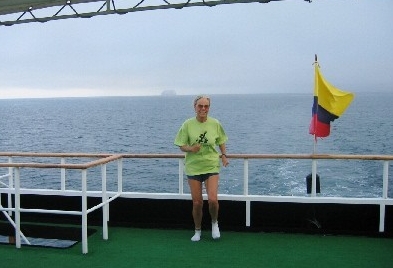
Ruth running on board the Radiance of the Sea cruise ship as it passed
in front of the Hubbard Glacier off the Alaskan Panhandle, August 1,
2003.
|

|
Snapshots
from
the
South America trip
Directly
Below:
Ruth
running on
the ship.
.
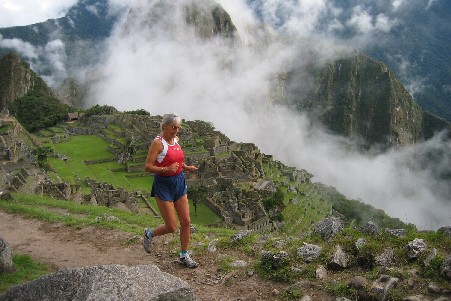
One snapshot down:
Running along a Macchu Pichu
trail |
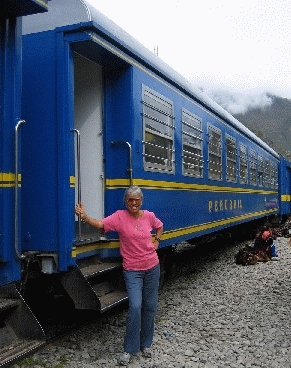
On the Right: Getting off the train at
Machu Picchu.
.
Below:
Bob, Ruth & llama at
Machu Picchu.
|
|
Center Left: a Blue-Footed Boobie at Galapagos.
.
Bottom
Left: another
running shot.
|
Small Snapshot: The bird with
the red
nose is a Frigate Bird "dressed
for romance."
.
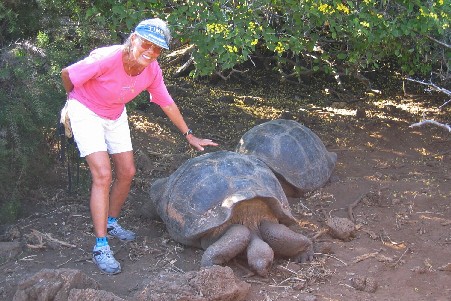
Lower Right: The famous Giant
Tortoises fooling around at Galapagos. |
|
THE TARAHUMARA OF BARRANCAS DE CUPRE
By
Ruth
Heidrich, Ph.D.
I
wanted
to see for myself! The Tarahumara runners are legendary for their 24-,
36-, even 72-hour runs. On top of that stunning stamina, they are
supposed to do this on a diet consisting primarily of corn!
Checking this
out, however, was no easy
task. The Tarahumara,
60,000 in number, live in Copper Canyon, or Barrancas de Cupre, a very
isolated area of Northern Mexico. To get there, we traveled by
bus to El Fuerte, a quaint, colonial town in the State of Sinaloa,
where we boarded the El Chihuahua Pacifico Railroad, also known
colloquially as 'El Chepe."

The
coaches
have been beautifully
restored and had
much
of the romance of riding
on the Orient Express.
|

The views crossing
the Sierra Madre were nothing less than spectacular. We climbed
from near sea level to a high of almost 8,000 ft. Getting there
entailed crossing 39 bridges and going through 88 tunnels, at times
with switchbacks so extreme we could see ourselves coming and
going.
|

Arriving
at Divisadero five hours later, we were greeted by a few of the shy and
reclusive
Tarahumara selling their primary handicrafts, beautifully
woven baskets.
|

An
early
French missionary named them Tarahumara. They call themselves
"Raramuri" with "rara" meaning "runners" and "uri" meaning
"steep." Because they are so reclusive, their culture has
remained relatively unchanged for the hundreds of years they have lived
in these canyons, four times the size of the Grand Canyon in the
U.S. Originally, they lived on the less steep areas, the fertile
plains and the valleys, but with the encroaching Spaniards and
Mexicans, they were pushed into the steepest cliffs.
Here, the soil was poor and growing
their primary crop, corn, was very difficult. Periodic droughts
have added to their problems. As a result, an incredible 70% of
the children die before reaching age five from devastating malnutrition
from not enough calories, polluted drinking water, and parasites.
Nevertheless,
if a child survives, he or she becomes a runner.
They grow up playing a game called "Rarajipare." Two teams
consist of
seven people on each side with a single ball. A player lifts the
ball onto the top of his foot and flips it as far as he can. The
rest of the players run to it, with either team gaining
possession. When the last player remains, the game is over.
This may take up to three days - and nights.. They play with
lighted torches after dark, and their only food is tesguino, milled
corn mixed with water to
a drinkable consistency. This is the mainstay (75%) of Tarahumara
diet, with the remaining food being beans and squash. They also take
the
milled corn as their sole food when traveling, since it is lightweight,
doesn't spoil, and is easily prepared by mixing it with water in a half
gourd they carry with them. This gives them great stamina and,
more
importantly, none of them appeared to be protein or calcium deficient
with
this plant-based diet.
|

They are such good runners that, for
example, in the Leadville 100-miler in 1991, the Tarahumara took first,
second, and fourth places. All of this was run on shoes
consisting of old tires cut into soles and tied onto their feet with
sisal. In fact, most all the children wore these "shoes" as well.
|

|

|
|
The
Caribbean
Wellness Cruise
By
Ruth Heidrich, Ph.D.
It’s hard to
imagine going on a
seven-day cruise and ending it weighing less and being healthier and
smarter than when you started! Well, for
about 150 CHIP (Coronary Health Improvement Program) Cruisers, that was
the outcome.
On February 15,
2004, the only
non-smoking cruise ship, Carnival’s Paradise, pulled out of the Port of
Miami and headed for Nassau, Bahamas; Dominican Republic, and the U.S.
Virgin Islands. While at sea, the “captive
audience” was “treated” to lectures by Howard
Lyman, “The Mad Cowboy”;
Dr. T. Colin Campbell, “The China Diet Study”; Dr. Ruth Heidrich, “The
Ironlady”; Dr. Hans Diehl, CHIP leader; Don Alsbro, “Changing Habits”;
Heike Englert, Physical Therapist, and Larry Ulery, “Vitamin H – Humor.”
Each of the
speakers covered an
area of Wellness and made for a fascinating and challenging program – challenging for a few of those
who were dragged kicking and screaming because hearing about, and
eating good vegan food, was the last thing they wanted to do! Others heard for the first time ever that
dairy products, milk specifically, did not build strong
bones
but that running does! Dr. Campbell told
how casein (a milk protein) worked like an on/off switch for cancer,
and that eating animal products causes heart disease, stroke, cancer,
diabetes, and osteoporosis. Howard Lyman told how commercial cattle
production ruins our health, contaminates the environment, and that if
anyone thinks there is only a single case of Mad Cow Disease in this
country, they must be smoking California’s #1 crop! Hans Diehl told how
a diet including animal foods, with little or no exercise, and smoking
makes up the major portion of disease and medical costs in this country.
|

|
Dr. Ruth told how the change to a
low-fat vegan diet reversed her breast cancer and enabled her to
complete the Ironman Triathlon a number of times and increase her bone
density in the process. Don Alsbro talked about how to gain the
motivation to change habits and the four different stages of change.
Heike Englert showed us how massage relaxes muscles, stretching keeps
joint mobile, and how to exercise on the road with elastic bands. Larry Ulery, the “Good Humor Man,” told us
that having humor in our lives was essential to mental health, helps
relationships, and deals with stress. There
were also several accomplished musicians, including Lily Diehl, who
provided a concert treat for our aesthetic senses.
The “stars” of the show, however,
were the seven vegan chefs who prepared seven day’s worth of vegan
food, mouth-watering
in visual appeal and
|
titillating to the taste
buds. No one would ever believe that you could eat all you want of this sumptuous buffet, have so
much energy that you just couldn’t keep yourself from exercising, and still
lose weight!
Oh, yes, we also climbed up to Fort Charlotte, the highest point
of Nassau to see where pirates roamed, ran through the busy streets of
La Romana, the port town of the Dominican Republic, and hiked up some
very steep hills that surround St. Thomas and took in stunning,
tropical views.
|

|
|
Back in Miami, a few of us
super-lucky ones did an air-boat tour of the
Everglades where your
lucky reporter got to hold Snappy, a three-year-old
alligator!
I can’t
imagine a
better cruise,
can you?
Ruth
E. Heidrich, Ph.D.
Note: For more information about next
year’s
cruises,
contact Don Alsbro, dealsbro@sbcglobal.net. There
are two cruises in the planning stages, one in the Southern Caribbean
and the other, off the west coast of Mexico.
Top
of the Page: >click<
Back
to Dr. Ruth's Home Page: >click<
|
|